20
Mar 26

Does Your Company Have a Swine Flu Plan?

Looking at the news it seems that H1N1 (aka Swine Flu) may be the pandemic that Avian flu was expected to be. With organizations being hit BIG with fears of this virus hitting 25%-30% of Canadians this flu season regardless of our preparedness of a possible outbreak  after experiencing SARS  there is going to be a lot of public fear over this illness. Something like this could potentially and dramatically affect the operations of your business. It could cause a lot of confusion and disruption internally and also affect your reputation publicly as an employer and product provider. So addressing this issue I thought I would put down some  of my thoughts on preventative actions  in regards to communications and planning ( add your own, or call BS if you want… I dare you ;)  )

Before an outbreak: Looking prepared is going to be a big deal.  As schools are getting back in session there has been a big push for them to  be prepared and get the message out. Companies should be doing the same. Making employee’s aware of symptoms to watch for ( for them and their family members), encouraging hand sanitizing  and having an open and clear plan about what will be done during a company outbreak and how employees will be involved. In regards to your customers if you deal with any sort of food product or public facing service you want to clearly communicate your dedication to safety and what steps are being taken if a localized outbreak were ever to occur.

During an Outbreak: A key focus is going to be ensuring  that everyone keeps as calm as possible. A single  person should be in charge of all communications and queries regarding an outbreak, that way there is no confusion and all information comes from one location ensuring one cohesive message. There should be no reactive actions, instead they should be clear and deliberate. More importantly of all  it should be a clear and open process, all numbers and actions should be reported. Even if a question needs to be answered over and over again ( could require making a FAQ)


20
Mar 26

While you should never confirm the release of a phone without an official from the source, Engadget recently released news about a PlayStation portable phone that could see a release date sometime between now and early 2011. After a slow year in sales for the PSP and PSP GO this may or may not be an attempt by Sony to boost sales of their portable system and compete directly with their burgeoning competitor Apple. Whether this product does or does not see a release date the prospect of this brings some interesting questions:  As it currently stands the PSP be a competitor to the Iphone/Ipod touch for gaming? And should Sony stay in the handheld gaming space at all?

First lets look at whether Sony has a chance at competing with Apple. Since its launch in December 2004 the PSP has grown to a user base of 62 million world wide compared to more than double that with the Nintendo DS ( 135 Million) and


20
Mar 26

One Profile to Rule Them All

With the full membership launch of the @facebook.com email system, Facebook users have had thrusted upon them (in a good way) another feature that makes Facebook a more sticky site. Combining personal email with a a person’s personal network, Facebook has created another reason to be at the center of the public’s web activity.  But what if it if this were to become the case completely? Everyone having a single profile that is the center of their identity and all activity online.

I’ve thought about this previously and believe that Facebook has one more step towards coming this. With the use of Facebook Connect and the movement towards Facebook commerce the personal Facebook profile is becoming a central internet experience. What could be next for the website

Centralizing your web experience:

Instead remembering the logins and credentials for every forum, portal or service you use online these are instead connected directly to your persona. Instead attempting to remember or search through your personal bookmarks you can click directly into the sites you use. Your bank accounts, bills owing and other personal information can be accessed from a single location (think your own personal life dashboard). This persona of you online would be an amalgamation of your personal information and everything you do online.


But aren’t we supposed to be anonymous online?

There are definitely some downsides to having all of your online presence in one location. One big push towards this sort of thing happening is the fear that we will become essentially naked online putting ourselves completely out there. Your internet activity can be traced to one source potentially revealing that you like to play Dungeons and Dragons or perhaps have interests that are bit more out of the mainstream . There is also the regulatory fears surrounding such a online system. Can you trust Facebook or really any other company with essentially all of your online information? Will they use or abuse this information? What if there’s a screw up? I won’t even touch the government and regulatory concerns about that as that would be opening a whole other can of worms.

This may never happen! Why waste your time theorizing?

The thought of data and lots of it! Smart companies are bringing together data online for useful and profitable applications. Also I don’t think we realize how much of ourselves is actually online in so many different corridors of the web. How  much of ourselves we have access to, give out and have tracked about ourselves. We create our own ‘internet footprint’or some would say even a trail of ourselves online and there are firms who work to track and amalgamate it.

So there is my random thought for the time being. If anyone wants to add to the pool feel free to do so!


Want to reach me outside of this ‘data stream’ I can be contacted at kevin@kevrichard.com or on twitter with @kevrichard.


20
Mar 26

More and more the battle for computer processor speed seems to be becoming less of an important factor in developing hardware.With current speeds going much faster than previous generations and current applications becoming more web based any significant boosts in speed going forward would be great but not be put to full use. With the recent launch of AMD’s new APU (Acellerated processing unit) chips


20
Mar 26

Digital News Summary- 4.19.15

Hey blog…. so long time no see.  I’m going to try to get more content up here in the weeks to come.


20
Mar 26

Impact Analysis: Facebook Reactions


20
Mar 16

Impact Analysis: The rise of VR at SXSW 2016

Virtual reality (VR) got a boost in attention over the last few weeks with high-profile announcements and campaigns at  SXSW and the Game Developer Conference (disclosure: Samsung is a client I work on). Coming out of these conferences though, the question now becomes ‘so what’? You may remember agency strategists clambering on how Meerkat and Periscope apps were the ‘next big thing’ out of SXSW 2015, but are almost nowhere to be seen now. Looking at VR in a similar light, the product has some substantial barriers to mainstream acceptance; cost, ecosystem size, and usability.

Photo Credit: https://www.flickr.com/photos/nanpalmero/

Photo Credit: https://www.flickr.com/photos/nanpalmero/


Getting to the ‘so what’? 

I feel we are still a few years and product iterations out till VR truly hits the mainstream. The question then becomes, what value are we then able to pull out of the ‘Year of VR’? Virtual reality as a concept is a means of escape and an immersive experience. Perhaps what marketers should take away from the conference is the idea of depth and experiences in what they are trying to promote instead.

Providing deeper marketing experiences

I  don’t think VR technology is entirely out of the picture yet. For larger brands, there is still the availability of 360 videos that provide deeper visuals on a consumer’s mobile device.  Otherwise,  being better at telling a story about your brand, or about what your company does could be a great focus also.

Avoiding ‘The Next Big Thing”

Not to sound jealous because I’ve only gone once…. but a fault of a conference such as SXSW is that those who come away from it try to grasp at what the next big trend in marketing/tech will be. In my honest opinion, changes are more likely to happen organically and over time (Ex: Snapchat  as a viable platform) rather than overnight. I found SXSW to be more of a general learning experience where marketers can see more of the ecosystem around them, and be able to perfect on the basics. The need to jump onto another big trend is potentially dangerous, resulting in lost time and money for something that isn’t tested and perhaps not quite strong enough to be in the public eye.


13
Mar 16

Impact Analysis: Facebook Search Recomendations

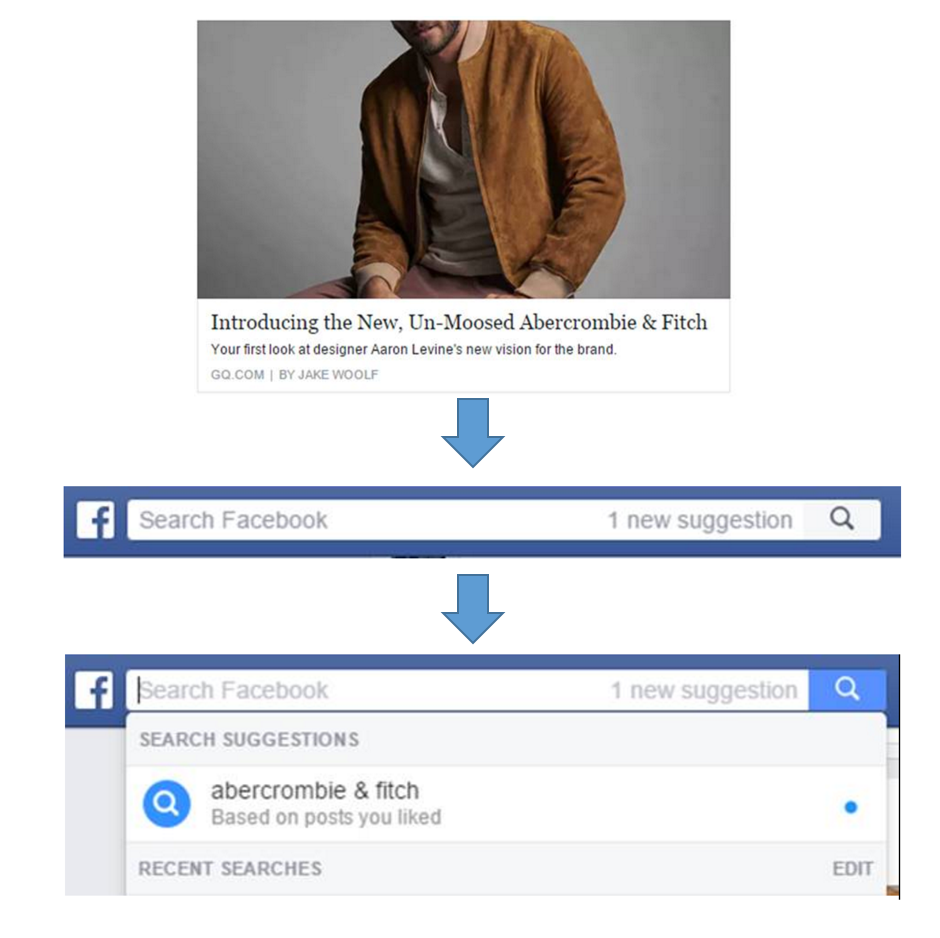
Something I spotted last week that caught my attention was Facebook’s new ‘Search Suggestions’ feature. Essentially based on content that you engage with,  you are near instantaneously served a suggested search topic. I’ve demonstrated it further in the example below:

Facebook Search Suggestions


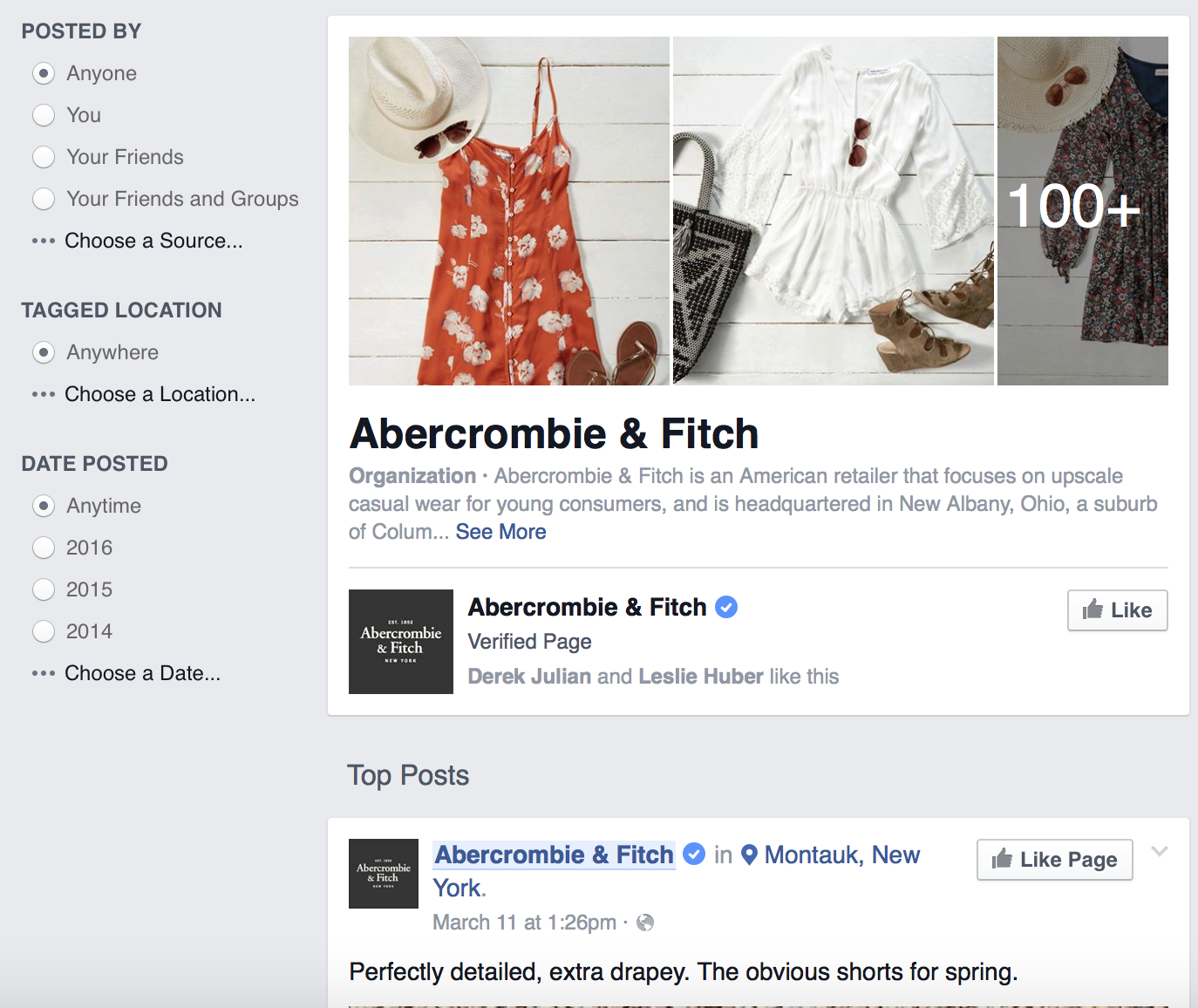
The steps I followed in this interaction were as follows: I liked a post from my newsfeed (in this case an article for Abercombie) and within a minute a ‘suggested search’ popped up in my search bar. This ended up  leading me to explore more about the brand (below).

Screen Shot 2016-03-13 at 4.44.16 PM

Implications?  

My first reaction was this was sort of creepy, but also if done correctly might customize my experience on site even more. Thinking about it even further, for a company or media outlet on Facebook this has some notable  considerations:

Where a brand/product gets mentioned: In the example above I had engaged with GQ, a publication I enjoy from time to time. Making sure that brands are visible on publications that their consumers are on ensures a higher likelihood of a ‘suggested search ‘ to your own or further related content. When the user also clicks through to the search they will also have content they may enjoy on the subsequent search result.

How consumers discuss a  brand: Clicking through the search also means that mentions from a user’s friends along with other related mentions are displayed. A positive or negative statement may have an effect in swaying a person’s opinion one way or another. Managing issues and encouraging your fans to advocate and share positive experiences about  your brand will be key in this regard.

SEO/SEM ramifications? On top of ensuring that content is engaging (moving it higher up in search), optimizing branded content so that it appears in relevant conversations is also a consideration. Facebook search isn’t as measurable as Google (yet…)  but being mindful of where content appears outside of the fan page newsfeed is also important.


25
Feb 16

Impact Analysis: Facebook Reactions

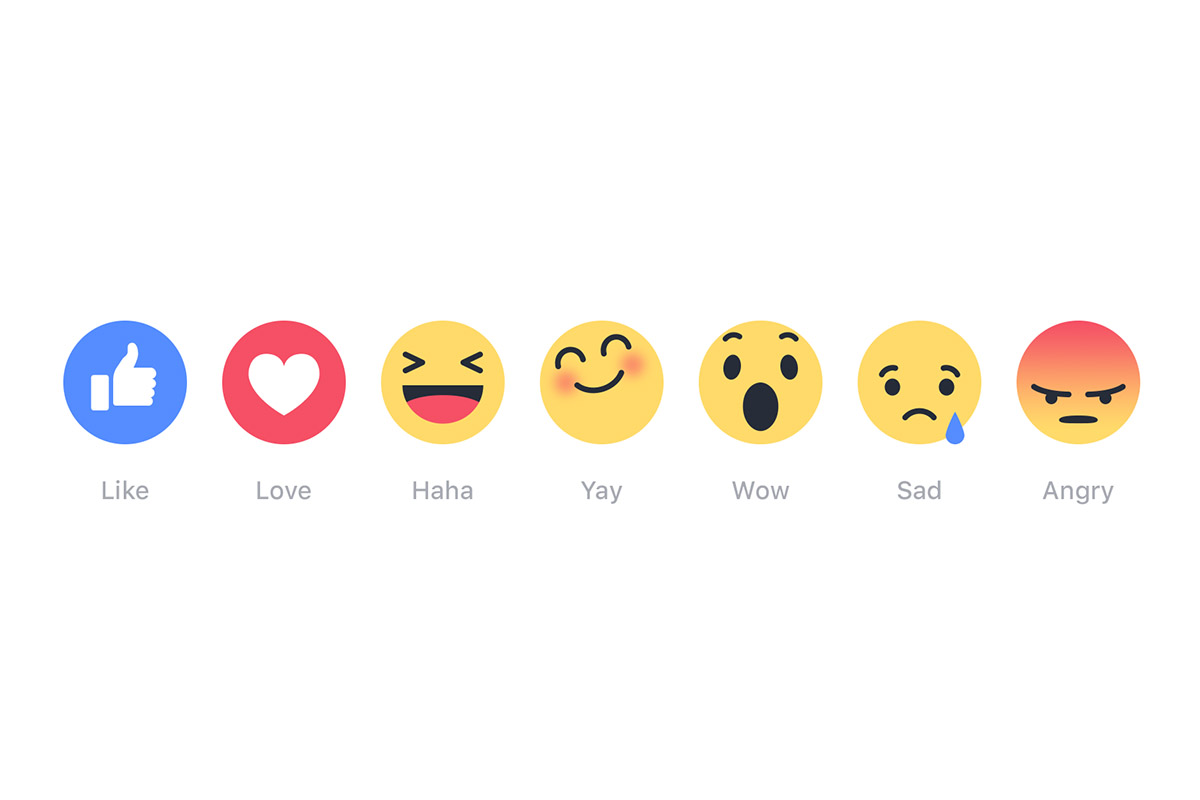
Yesterday we saw the addition of  “angry”, “sad”, “wow”, “haha” and “love”  join the familiar ‘like’ when it comes to user response to Facebook content. While previously content was measured by a single like or negative action (unsubscribe, report, unfollow) this new set of engagements brings a new layer of complexity to the simple Facebook post.

Effects on the newsfeed?

What Facebook has yet to describe is the effect that each new reaction has when it comes to ranking content. Will content receiving more “Loves” get higher newsfeed priority over content that receive just “Haha” or “Like”? What does getting an “angry” mean?

Content Considerations

With a  previous focus on getting single engagements, whether its more video views, comments etc., adding 5 new reactions could throw content strategy for a loop. A brand with a focus on humor related content could instead now rank posts by how many “Haha”s it gets.

Another thing to consider is when would “angry” and “sad” reactions come into play. Are there particular moments when a brand wants to generate particularly strong emotions?


emotions

How to Track? 

Measurement structures will also be affected by the introduction of these new engagements. By having the ability to chose the ‘angry’ engagement, measuring by total engagements doesn’t necessarily prove if a post is more or less successful anymore. Already a ‘Love’ may have more value than a simple like, and a post made to engage fans with ‘Haha’s could be deemed a failure if instead it received ‘Angry’ and ‘Sad’.

Conclusion

We still need to see the full impact of  how the new ‘reactions’ feature alters content flows.  An observation I’m already seeing is that a as a single click option (versus a hover and select) general ‘like’ engagements are still the most dominate engagement.  After a week or so (once initial excitement has died down) there should be enough data to evaluate the impact and see what (if any) changes to tactics and overall strategies need to be done.


08
Oct 15

SQL Beginners Cheat Sheet

So its been a while again, but push comes to shove and I’m determined to get back on to making a return to this blog. I’m on a bit of a skills development fix at the moment and decided here would be a great spot to report back on what I’ve been doing and to create some documentation on the key learnings.

I recently went through a beginners course on SQL through Code Academy (link to the course here) which I found really interesting and potentially useful for future endeavors.

SUMMARY 

What is SQL? Known as a ‘Standard Query Language’ its a method of organizing and summarizing data. My general thinking when it comes to this is that taking a structured dataset it allows the user to summarize and manipulate the data. In the case of multiple datasets, it connects them through a common tie so the user can get a better understanding of how they interact.

Why is it potentially useful? I’ve experienced SQL in the context of a data tool where the language organizes raw data in such a way that its  a readable output for the end-user. When thinking about it in terms of even a basic excel spreadsheet, the language allows for the data to be summarized and reformatted saving the user from having to do a lot of manual work.

Below is a select set of terms from the course and example code:

TERMS/COMMANDS:

; is used as an ‘End statement’ and is placed at the end of a command. It tells the system to move to the next query statement.

There are three basic functions of the SQL language: To BUILD, ANALYZE or JOIN data tables.

 BUILD:

CREATE TABLE: is a command telling the system to build a new data table.

table_name(***): labels a table for use in queries and joining with other tables.

column_1 data_type: defines what data goes into a particular column (can be text, date, number etc.) These can be layered up to create a series of columns

INSERT INTO: is a formatting command used for define the set columns. Following this, column titles can be added ex: (id, name, age).

VALUES: This is a command used to enter in individual entries. Its formatted as VALUES (row value 1, row value 2…);

UPDATE: used to change entries in a table. Using ‘SET’ and ‘WHERE’ entries, data within the table can be altered

ALTER TABLE: Where as UPDATE alters an entry, ALTER TABLE allows the user to change or add data columns.

DELETE FROM: Deletes rows from a table.


Example Code:

CREAT TABLE table_name (
 column_1 data_type,
 column_2 data_type,
 column_3 data_type
 );
INSERT INTO celebs (id, name, age)
VALUES (1, 'Justin Bieber', 21);
 SELECT *FROM celebs;
UPDATE celebs
 SET age = 22
 WHERE id= 1;
 SELECT *FROM celebs;
ALTER TABLE celebs ADD COLUMN
 twitter_handle TEXT;
 SELECT *FROM celebs;
DELETE FROM celebs WHERE twitter_handle IS NULL;

ANALYZE:

SELECT *FROM ‘table name': displays all data from the labeled table the SQL interface. The * is used to notate ‘select the whole table’. Other commands such as ‘SELECT DISTINCT’ can be used to summarize a table further based on a column or row entry.

BETWEEN: Is a filter option for the use of numerical data.

ORDER BY: organizes a data set. A related command DESC/ASC(aka: Descending/Ascending) can be used to organize numbers by a set parameter.

LIMIT: Sets maximum number of rows pulled from a dataset.

GROUP BY: organizes data by a specific column entry (example: type of apple).

COUNT: summarizes numerical data by a category (example: how many entries contain X)

SUM: Counts up the numerical data of a particular column in a table ( Ex: How many impressions in total).

MAX(): finds the largest value of a criteria.

MIN(): finds the smallest value of a criteria.

AVG(): finds the average of a criteria.

ROUND(): rounds decimal numbers to a specific integer.

EXAMPLE CODE: 

SELECT* FROM movies WHERE imdb_rating >8;
SELECT * FROM movies
 WHERE name LIKE 'Se_en';
SELECT *FROM movies
 ORDER BY imdb_rating DESC;

SELECT price, ROUND(AVG(downloads),2) FROM fake_apps GROUP BY price;

JOIN:

JOIN: creates a common column between two tables which joins the data set together (ex: id_actormovie JOIN ID_Actor)

ON: states the parameter of the join.

Inner Join: joins entries when a join criteria is met.

Left Join: Combines two tables together side by side and provides a NULL value when the join parameters are not met.

AS: When joining a table this allows columns of the joined table to be renamed without affecting the original unjoined tables.

EXAMPLE CODE: 

SELECT
albums.name AS 'Album', albums.year, artists.name AS 'Artist'
 FROM albums JOIN artists ON albums.artist_id = artists.id WHERE albums.year >1990